Across St. Louis and the United States, there has been increased effort to recover histories of black communities that once were, many of them lost to a familiar pattern of isolation, divestment, displacement, and erasure. Social memory of these communities has been recovered through an array of documentary, preservation, and remembrance efforts led by artists and others. Lost St. Louis places including Chestnut Valley, Mcree Town, and Mill Creek have been remembered through tours, exhibitions, and other memory work, as have largely displaced black communities of these and other areas including Creve Coeur, Brentwood, and Clayton. The remembrances celebrate the resilience evident in determined place-making while also bearing witness to repetitive cycles of displacement through racialized agendas of “progress.” These remembrances counter the disappearances, recovering a long-standing presence and acknowledging our belonging.
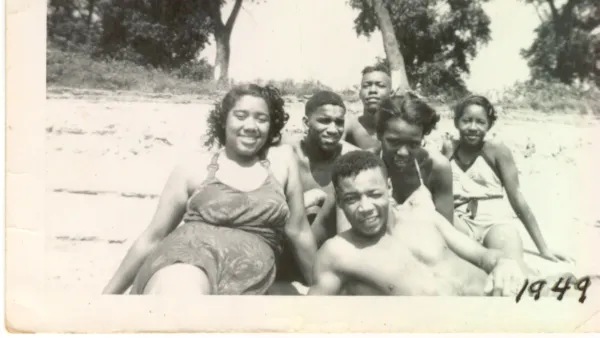
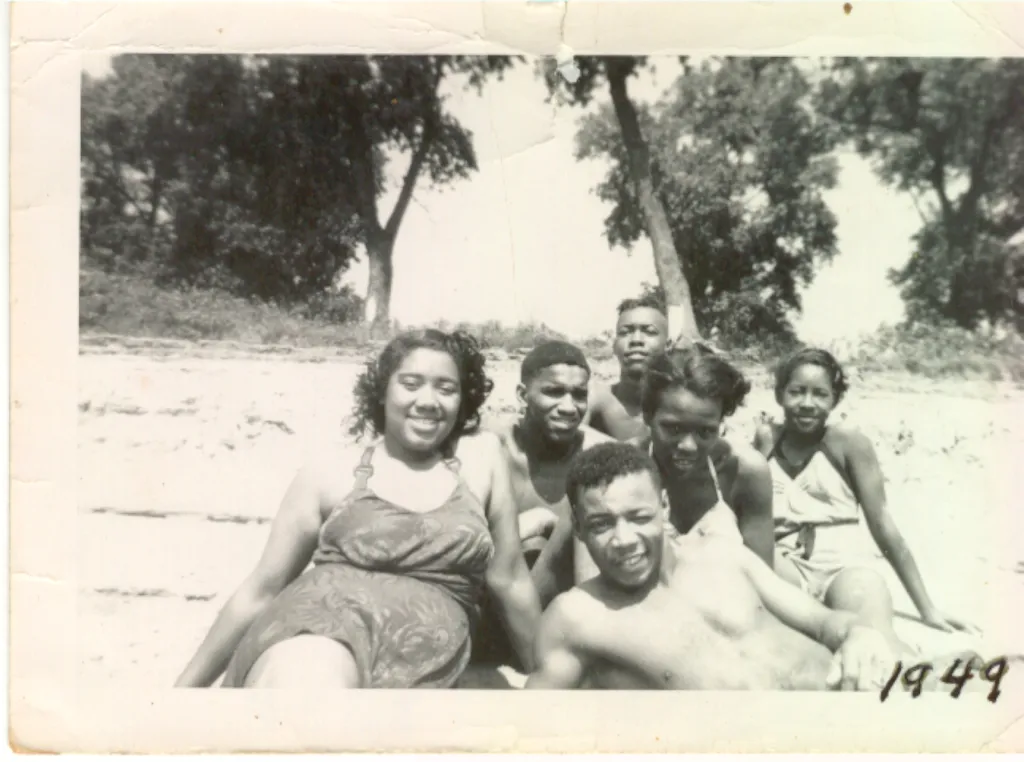
While exploring black histories of St. Louis’ rivers I came across another community largely lost to social memory, the majority black community of what was Kerr Island, on the east bank of the Mississippi River, near Venice, Illinois. I first encountered the island through a photograph on the website of the genealogist Deb Davis, showing her mother with friends enjoying the beach at Kerr Island in 1949, a beach Davis described as a once-popular recreation area for African Americans in the area (fig. 1). The picture captured my interest in part for the revelation that there was once a recreational beach on the Mississippi, and because there are so few historical photos of black joy in St. Louis. The account also reminded me of the recently resurfaced history of displacement at Bruce’s Beach, an African American beach resort that once was in my hometown of Los Angeles. I had to learn and share more about the forgotten black history of Kerr Island.
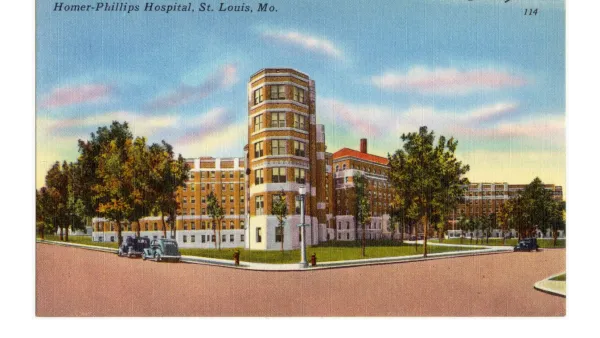
The documented African American history of Kerr Island begins in some ways with its namesake, Matthew Kerr (1777-1857), a Pennsylvanian who became a merchant in St. Louis around 1807. The St. Louis Integrated Database of Enslavement (SLIDE) links him with both ownership and manumission of enslaved people between 1824 and 1853, obscuring the exact nature of his entanglements with slavery. We have learned from these records that Matthew freed a man named Nelson Kerr in 1834, that Nelson then freed his wife Rhoda Kerr in 1838, and that together they freed their daughter, Sarah Kerr, in 1847.
The island was named after Matthew Kerr around 1826, when he established a horse-powered ferry crossing the Mississippi River there. Matthew Kerr apparently traveled regularly to his hometown of Philadelphia, returning with goods he sold in St. Louis. Perhaps this also relates to his ties to slavery and freedom. There is little in the historical record about Matthew Kerr or Kerr Island over subsequent decades, until the 1880s, when a community took root on the island. By 1880 a growing population – especially white and black migrants from the lower river valley – began settling on Kerr Island. Residents initially leased lots for $1 per year from the Madison County Ferry Co., a token amount preventing claims to squatters’ rights. Whereas many early occupants moved on, unequal access to housing owing to segregation, cost, and more concentrated impoverished black residents. These leaseholders and likely others built mostly improvised structures on small parcels of land, with little in the way of infrastructure or municipal services. Kerr Slough was mostly filled by the 1900s, connecting the area to the mainland, but the name Kerr Island held (fig. 2).

By 1940 Kerr Island was home to an estimated 2,000 people, ninety percent of whom were African American, and an estimated twelve businesses and six churches. By then many residents paid $1 in monthly rent for holdings that grew increasingly tenuous, reflecting a broader pattern of displacement in the region, and foreshadowing the industrial takeover of the metro St. Louis riverfront so evident today. That year the ferry company and the estate of the former Missouri governor and president of the 1904 World Fair, David R. Francis, leased a portion of their jointly owned land to Union Electric Company, which later became a subsidiary of Ameren Corporation. Union Electric began evicting Kerr Island residents, ordering fifty families to leave immediately so that the area could be used as a coal yard. Though few traces of the community remain in the area that is now Ameren Energy Center, the Kerr Island community did not leave quietly, or quickly. Newspapers from the 1940s to 1960s document an array of strategies and alliances mobilized to protect the Kerr Island residents from displacement, and an evolving rationale for removal which began in the 1940s with a focus on property rights. Residents initially countered these with appeals to human and civil rights. Small American flags were hung from their doors as the 1940s wave of evictions swept through (fig 3), with residents seemingly hoping these expressions of belonging and patriotic sentiment amidst a global war in defense of democracy might yield greater compassion and a right to remain ("Kerr Island: More than 300 residents facing eviction from their homes," St. Louis Star-Times, Aug. 26, 1940.).
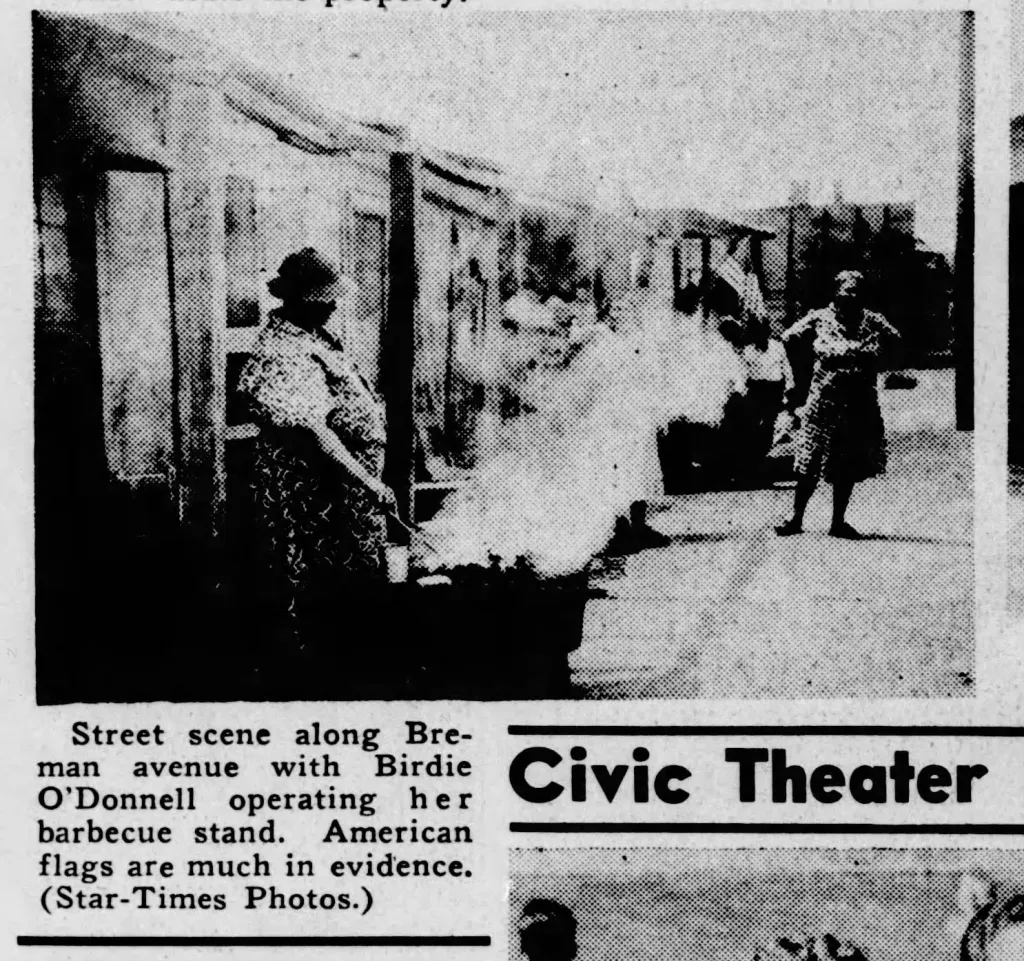
Any protective benefit of flag-flying was short-lived. Forty-nine families were forced to move in 1940, some of whom had been in their homes for thirty years. Across the river, in St. Louis, the 1947 Comprehensive City Plan authored by nationally influential urban planner Harland Bartholomew was paving the way for Black neighborhood displacement by designating areas obsolete and recommending clearance and redevelopment. Another mass eviction followed soon after on Kerr Island, in 1951, when Union Electric acquired an option to buy Kerr Island from underneath the remaining community, and ordered another 350 families to leave. Some were temporarily spared after Illinois governor Adlai Stevenson asked the company to postpone the mass eviction until residents found other housing, citing the hardship of an intended displacement over the winter months ("Stevenson asks for eviction stay," St. Louis Post-Dispatch, Feb. 23, 1951, p.3). Community leaders similarly urged compassion, and recognition of the decades of work spent transforming the flood-prone land into a viable community.
Newspapers beyond the region reported on this growing struggle between marginalized residents and corporate power. In August 1950, the summer after beachgoers were photographed enjoying Kerr Island, the New York-based communist newspaper Daily World denounced the “coal-warriors” of Union Electric “encroach[ing] upon the rights of the islands’ citizenry.” Notwithstanding a company slogan to “live better electrically,” the newspaper noted, “Coal dust blankets the houses, the small gardens, the Sunday dinner, and the Monday wash. Now the giant company has bought the whole island…to make room for more coal” ("Pile Coal on Kerr Island: Evict Negroes," Daily World, Sunday, Aug 6, 1950).
Kerr Island residents, their allies and other stakeholders also organized to secure the community's future, with Lovejoy, IL physician Earl Williams, East St. Louis attorney Billy Jones, and Kerr Island grocer Hugh Hairston playing key roles. Williams purchased 52-acres of land just east of Kerr Island, offering properties in a new housing development called ‘Williamsville’ to those facing displacement. Newspapers estimated that only 15 percent of purchasers were Kerr Islanders, the remainder drawn from St. Louis. This is in part because residents intended to stay. To that end, Billy Jones represented a community group called the Kerr Island Welfare League in negotiations with government and energy company officials to purchase Kerr Island property, and secure agreements to build roads, plumbing, schools, and other infrastructure. Grocer Hugh Hairston led the Kerr Island Realty Company, meant to enable residents to purchase plots of land once the sale was complete. The realty company agreed to purchase the land from the ferry company for around $60,000 in 1951, making an initial down payment of ten thousand and agreeing to a series of monthly payments to complete the transaction ("Kerr Isle group buys homes area," St. Louis Argus, Nov. 31, 1951, p.1).
Black newspapers had long tracked the plight of the Kerr Island community and rallied public support. After reporting on waves of evictions and threats of banishment, the St. Louis American hastily announced in 1951 that “residents of Kerr Island, Venice, Ill., have removed the last threat of eviction of their families” through the purchase agreement ("Long fight against eviction won..." St. Louis American, Nov. 29, 1951, p.2). The Chicago Defender similarly reported that the threat of eviction had been removed by the purchase of the land, noting that the Madison County Housing Authority planned to build a housing project in Venice to accommodate some of the residents ("Saving of homes on Kerr Island solved" Chicago Defender, Nov. 17, 1951, p.5).
Yet there were early signs that celebrations were premature, as surrounding communities seemed poised to resist the prospect of integration with predominantly black Kerr Island, and the sale could fall through. The Chicago Defender had also noted that area business leaders opposed its “imposition” on Madison County schools, and fund raising to pay the tens of thousands remaining on the land purchase agreement also floundered. The East St. Louis branch of the St. Louis American newspaper announced an initial pledge of five dollars. Local sausage and insurance companies each pitched in just five dollars as well, bringing the total raised in the first few months to a mere fifteen dollars. It is unclear how much was ultimately raised but by 1954 the agreement was off, the riverfront half of Kerr Island had been sold to Union Electric, and several hundred families faced eviction again ("Half of Kerr Island residents told to move by April 30" Belleville News-Democrat, March 26, 1954, p.18).
A decade later, a St. Louis Post-Dispatch article in 1966 announced that the last 270 residents were soon to be displaced, possibly without any relocation assistance. By then the narrative had shifted as well. Efforts to raze Kerr Island had begun in the 1940s with the attempted sale of the land to Union Electric, and holdouts withstood decades of apparent efforts to "bury them in coal." By the 1960s the rationale had turned to elimination of "blight," and the sudden urgency of completing a promised “scenic highway” that would cut through Kerr Island: the “Great River Road” ("Last of the impoverished residents of Kerr Island to be uprooted to make way for the Great River Road," St. Louis Post-Dispatch, Oct. 27, 1966, p.99).

The recent destruction of the Mill Creek Valley neighborhood across the river in St. Louis was replaying on Kerr Island, largely through machinations of state and federal anti-poverty and highway officials, with an assist from sensational news on the inevitability of “slum clearance.” Newspapers detailed the poverty of remaining residents, and the percentage of residents receiving aid, with no mention of the grit and resilience that kept the community alive for multiple generations, the good times at the beach, and only recently dashed prospects of neighborhood investment and development. After nearly a century of residents fighting to secure a future on the land, and seemingly finding one, a new narrative reduced Kerr Island to “the worst pocket of poverty” in the region, where there was nothing worth saving, and the land was better suited to the unlikely combination of coal storage and a scenic highway ("Kerr Island people face mass removal," Alton Evening Telegraph, Sept. 1, 1966, p.2).
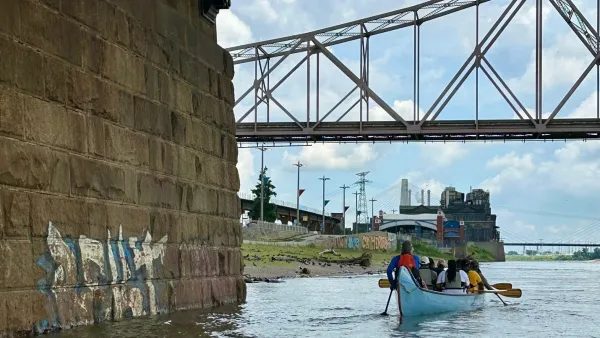
So the next time you are taking in the unimpressive views of heavy industry along the Great River Road, or maybe floating down the Mississippi on the Black Heritage Water Trail near the foot of the McKinley bridge, take a moment to remember the hardy people of Kerr Island, and imagine enjoying their beach!