The WashU & Slavery Project offers scholarships to subsidize immersive learning experiences that help students situate the reckoning with slavery and its legacies in St. Louis, MO within a national and global context. In this essay Sylvia Sukop, a PhD student in the Department of Comparative Literature and Thought, shares insights from her studies in Poland, Germany and Austria.
In 2022–23, I participated as a graduate student in the Memory for the Future yearlong studiolab co-led by Professors Geoff Ward and Anika Walke. Together we examined forms of commemoration that might address ongoing legacies of violent histories; and we explored, in particular, the possibilities of reparative memory work. As a direct outgrowth of our collaborative learning, I have grounded my PhD research in the interdisciplinary field of Memory Studies. I’m interested in weaving transnational connections among commemorative sites and practices related to histories of racial violence, including U.S. slavery and the Holocaust. What strategies do these efforts share? What challenges do they face? What impacts do they seek?
Thanks to an Immersive Learning Scholarship from the WashU & Slavery Project, this summer I was able to visit three European cities where local memory activists and artists have confronted histories of racialized violence: Będzin, Poland; Würzburg, Germany; and Vienna, Austria. These site visits and the interviews and photography I conducted along the way generated new primary research on commemorative initiatives that have received little critical attention (Holocaust memory projects in Będzin and Würzburg), and allowed for a firsthand visit to a 110-year-old statue honoring an antisemitic politician which has been mired in controversy and whose fate remains unresolved, similar to Confederate monuments being debated in the U.S.
Like memory activists everywhere, those I met in Europe are invested in grappling with difficult memory in their own local historical and political contexts. It takes a high level of personal dedication, persistence, and creativity. None of their work happens quickly; in some cases, the work will never be done. Sometimes public debates about memorialization become the site of memory.
This immersive learning opportunity exceeded my expectations, and I came away from the trip brimming with new experiences, insights, questions and vital networks that will shape my dissertation project going forward.
Będzin, Poland
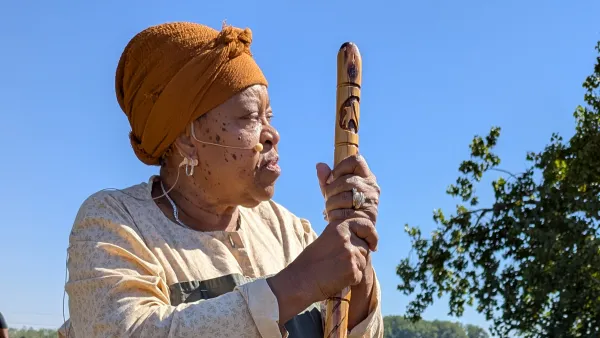
I have a longstanding interest in reenactment as a commemorative practice. Here in Saint Louis, I have been following the work of public historian and educator Angela da Silva, a direct descendant of Missouri slaves committed to preserving their memory. Her creative practice—researching the stories of enslaved individuals, then writing characters and episodes for public performance in various settings—dates back more than 20 years.
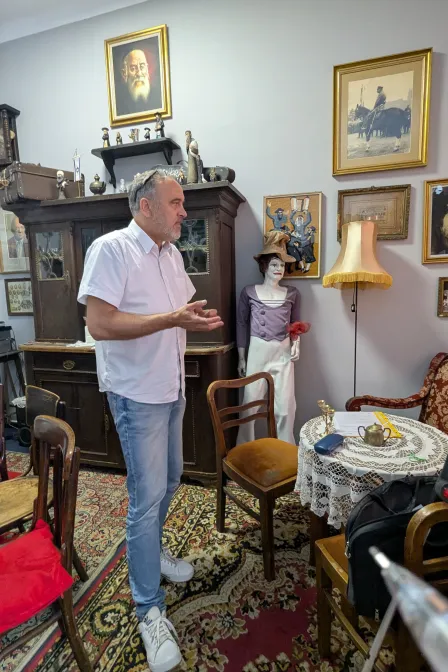
I began to wonder if reenactment had ever been used by Holocaust memory keepers and soon discovered several communities in Poland where this had been the case. As part of my summer research, I visited the town of Będzin and interviewed Adam Szydłowski, the creative force behind two ambitious reenactments of Nazi roundups and deportations, one in 2010 based on events in 1939 at the beginning of the town’s occupation, the other in 2011 based on events at the end, in 1943. Szydłowski, like da Silva, has pedagogical aims, in his case to educate the next generation about crimes committed in his hometown during WWII. Ahead of each performance, he worked for a year with local teachers and students to educate them about the town’s long Jewish history, the period of brutal Nazi occupation, and the forced labor, deportation and murder of thousands of Jewish residents that ensued. The students and other community members then participated in a collective performance on the very streets where the violence took place 70 years earlier.
Both Będzin and Saint Louis are smaller cities (populations under 300,000) in which performative reenactment staged in authentic historical sites has emerged as a vital mode of remembrance. In each place, what are the creative processes and goals behind performing memory? Why is community participation and specifically the use of nonprofessional actors key to the chosen modality of these guardians of local memory? What challenges must be overcome for such projects to succeed, and what criticisms addressed?
Würzburg, Germany
As the daughter of German immigrants, I have an especially intimate connection to Lower Franconia, the region in Bavaria where my mother was born. As a child, I frequently visited the farm where she grew up and the regional capital of Würzburg. This summer, Würzburg became an in-depth stop on my research trip and I was able to immerse in the city’s wide range of Jewish remembrance projects and resources. These initiatives are primarily led not by descendants of the thousands of Jews who once lived there and were deported under the Nazi regime to ghettos and extermination camps in Eastern Europe, but rather by an all-volunteer “memory circle” (Erinnerungskreis), primarily made up of non-Jewish residents. Their efforts are led by Benita Stolz who served 30 years on the City Council and, now in her 70s, is fully dedicated to this work.
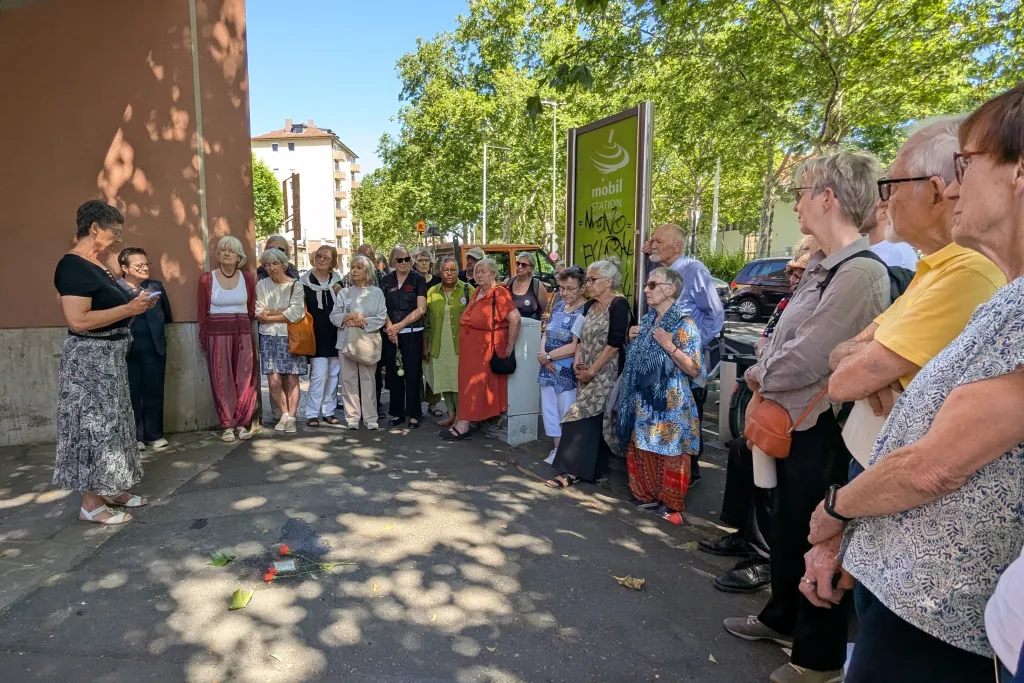
My visit coincided with several important developments in Würzburg’s commemorative initiatives. I was on hand for the physical expansion of a Jewish deportation memorial initially dedicated in 2020 (DenkOrt Deportationen 1941–1944), and interviewed the artist and architect who designed the memorial, Matthias Braun, while he was supervising the delivery and installation of new elements at the site. I participated in the laying of several new “stumbling stones” (Stolpersteine), small brass markers in the sidewalk commemorating victims of Nazi persecution, a distributed memorial with some 100,000 markers placed to date across Europe, 700 of those in Würzburg. I attended a public lecture presenting newly uncovered evidence detailing horrific medical experiments carried out by Nazi doctors at Würzburg’s women’s clinic (Frauenklinik). And I met with the director of the Johanna Stahl Center for Jewish History and Culture, and viewed video interviews from its archives with Jewish survivors from Würzburg describing the violence they endured.
I was deeply impressed by the robustness of Würzburg’s local memory culture, the level of local public awareness and engagement it engenders, the sustained support it finds from funders and partners, and the multi-directionality it embodies in a way that feels unforced, authentic to this community. After my immersive visit, I am affirmed in choosing this city as a focal point within my dissertation.
Vienna, Austria
Vienna’s Karl Lueger memorial statue posthumously honors the city’s mayor from 1897 until his death in 1910. A charismatic leader credited with modernizing Vienna, Lueger promoted virulently racist ideas as he leveraged rising antisemitism for his own political gain. Admired and emulated by Hitler, he remains a hero among neo-fascists in Austria today. The monument has long been the focus of activist intervention both for and against its continued presence in the city center, a dynamic similar to that surrounding Confederate memorials across the U.S.
Curiously, Saint Louis’s Confederate Memorial, taken down in 2017 following protests in the wake of Michael Brown’s 2014 murder and now being stored out of public view by the Missouri Civil War Museum, has ties to Vienna. The monument, dedicated in 1914 in Forest Park, was designed by Hungarian-born artist George Zolnay who trained at the Imperial Academy of Fine Arts in Vienna and later emigrated to the U.S. During my research visit in Vienna, I was able to visit the Academy’s archives and find documents related to Zolnay’s studies there beginning in 1887 at age 25.
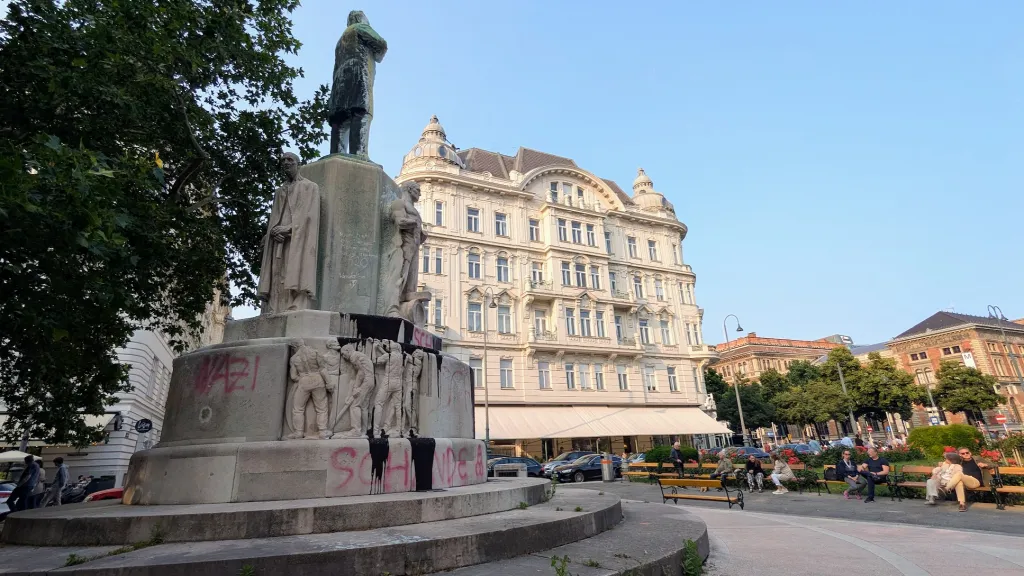
I’m interested in comparing how contemporary artists and activists have confronted relics of a problematic past in Vienna and in Saint Louis. Through Michael Rothberg’s lens of multidirectional memory, I ask: What does a monument signify to diverse audiences in evolving political contexts over time? Who has the right and the responsibility to make decisions regarding monuments in public space? In these two cases, what possibilities and resources exist for a reparative memory approach?
Thumbnail image:
Angela da Silva performing at the 2025 Mary Meachum Freedom Crossing Celebration (photo: Sylvia Sukop, 2025)
Header image:
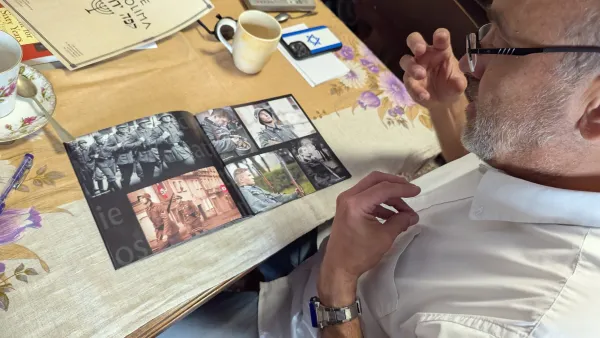
Adam Szydłowski with commemorative booklet from the 2011 reenactment in Będzin, Poland (photo: Sylvia Sukop, 2025)