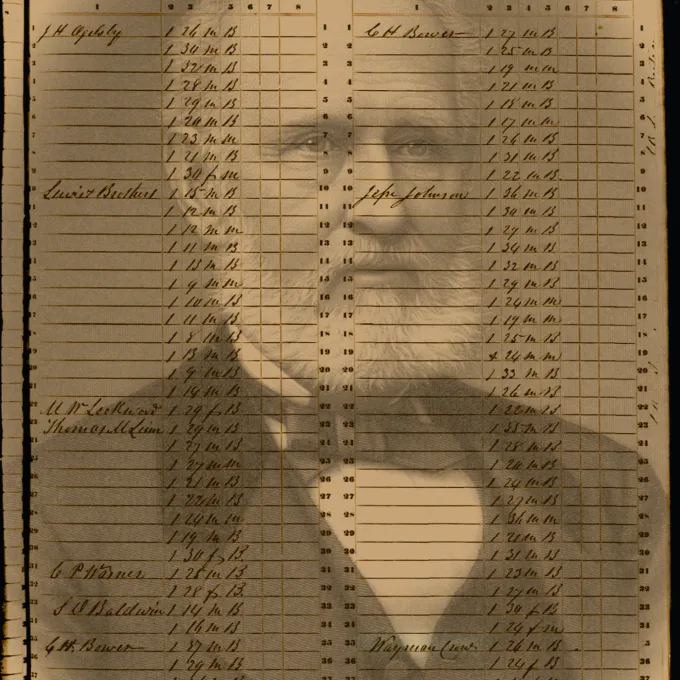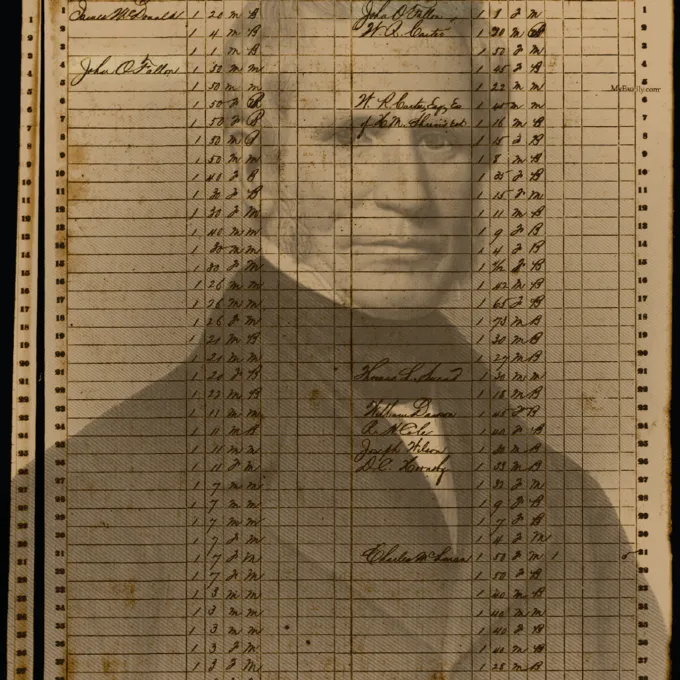
Pictured: John O’Fallon, 1860 U.S. Census – Slave Schedules, St. Louis Township; John O’Fallon, Steel Engraving by A.H. Ritchie, 1883. Courtesy Missouri Historical Society. Photo composite by Ian Lanius.
John O'Fallon
John O'Fallon (1791-1895) was a nephew and later adoptee of William Clark and a former Captain (not Colonel) in the U.S. military. He fought in the War of 1812 and a series of battles with Native Americans commonly termed Indian Wars. He amassed great wealth first by supplying colonial expeditions hastened in large part by his uncle, and later investments in land, banking and railroads which built on these networks. After President Jackson signed the Indian Removal Act (1830), John helped his uncle remove Native Americans living from their lands east of the Mississippi River. O’Fallon was likely the wealthiest man and largest slave holder in St. Louis at the time of WashU's founding (1853). The new university was briefly named O'Fallon Institute before becoming Washington University, and O'Fallon was an early trustee (elected 1855) and major benefactor of this institution as well as of Saint Louis University. A prominent and active member of Missouri’s slaver aristocracy, O'Fallon enslaved more than seventy-seven (77) people, according to data collected from the 1830 - 1860 censuses. William Clark also bequeathed an enslaved family - Easter and her children Hannah, Harry, and her infant son - to John O'Fallon in 1817. O'Fallon is reported to have served as Foreman of the Grand Jury that declined to indict the racist mob responsible for the 1836 lynching of Francis McIntosh, and to have led St. Louis's Anti-Abolition society in the late-1840s. In July 1856, three people enslaved to O'Fallon sought to escape their bondage. One of WashU’s early buildings, O’Fallon Polytechnic, opened in 1867 at 7th and Chestnut Street, the very intersection where Francis McIntosh was burned alive three decades earlier.